Sunday, July 21, 2013
Practicing Posture and Other Habits
Where to start. How about with definitions of the word "practice?" It is such an interesting word. I first knew it to mean doing something over and over to gain skill or expertise, as in "practicing the piano." Then I heard people talk about "practicing law" or "practicing medicine." This wasn't someone trying to become more skilled, this was a skilled person just doing their job. Then I knew it as trying to follow or observe something, like "I practice such-and-such religion." Finally I became familiar with the definition that used the word to mean doing something habitually, as in "the practice of meditation."
I love all these interwoven definitions, particularly when it comes to thinking about meditation and yoga. I was thinking about it in yoga class, actually. I was certainly "practicing" the yoga poses (called asanas) so I could get better at them. And doing yoga regularly is also a "practice," a permanent life activity. A habit (I hope), a mode, a way of being. Practicing my practice.
The instructor really made me laugh when she noted that the next pose was used to fight bad posture, or our "slouch-asana." I laughed loud enough to get her attention, and every time she used the "word" after that she looked at me and I laughed all over again. It was funny to me, thinking of the idea of a slouch as a yoga pose. "Now everyone - slouch-asana!" Finally, yoga I can do really well.
Then I thought more, and it became less funny and more enlightening. Slouching as a pose. Something we actually practice day in and day out, getting better at it all the time. We slouch when we walk, sit, stand, and sometimes when we lie down. We are so good at it that it takes years of dedicated work to un-slouch ourselves. And we don't just practice slouching to get to be more skilled slouchers, we end up doing it as a lifetime practice. A habit. A mode. A way of being. From the outside, some alien culture might imagine we have a deep belief in slouching.
It made me think harder. What else has moved into the status of an actual practice? What do I believe in so strongly that I "practice" it the way I do meditation or the way I brush my teeth? How about my constant stream of self-critical comments? That could be a practice - yes, self criticism as practice. Maybe self-hatred as practice. When did my practice start? I'm really amazingly good at it. Is there a love-asana that can be used to work against my excellent hate-asana? What would that look like? I don't mean it literally, although if there is a pose for self-esteem I'll practice it. I mean spiritual asanas. Poses of the mind and soul.
I think this is an interesting way to consider all the things I do on a daily basis, and how much of a grip they have on me. What's been glorified, in a way, with the status of practice? Should it be? How can that be changed?
What are your practices, good and bad? How do you set aside an honored practice, even a bad one, and put a new, healthy one in its place?
Your Hostess With Neuroses
Image credit/info: www.photoxpresss.com
Friday, March 1, 2013
Wow. It's been a while since I read a title for a blog post that had me actually nauseous. Here's the one that got me - "How is your love life related to your Mother?" Oh. Ewww.
Zoh, tell me about your muzher.
Remember that "Mom" is a real hot button topic for me in general. I'm estranged from my parents, mostly because of my mother's unresolved and untreated mental illnesses. Don't get me wrong - I have a great deal of sympathy for anyone suffers from mental illness; how could I not, given I am in that position myself? But protecting my boundaries means only interacting with people who want to get better; who want to be treated. My mother is not in that category.
So the idea that my past (or present) relationship with her reflects in my love life is utterly anathema. Even though it has to be true, of course. Our relationships with our parents form the basis for how we relate to almost every other person we meet. But love life? I reiterate. Ewww.
The other blog post says, "If you felt you didn’t get enough from your mother, perhaps you also feel that you don’t get “enough” from your partner." Fortunately I have a spouse who has been willing to work with me for many years, addressing both my issues and his, and we have a very good marriage. It takes plenty of effort, but it has really paid off for us. So I guess my first point is this - past (or present) events may have an influence, but they do not have to rule us. We can make changes in our current lives, through therapy, meds, meditation, or whatever, as well as through working with others on relationships. Difficulties are not a forgone conclusion.
The post goes on with a few other phrases that naturally get me going, but also get me thinking. Here's one: "Rejecting our parents only brings us suffering." I'll mention that rejecting them has brought me a lot of peace, and was the only way I was able to carve enough of a safe space to truly being healing. But that isn't really what the poster means - they mean a deep sense of rejecting them on all levels, not just not being in their physical presence. And I agree with that to some extent. Not being able to accept our parents for what they are is very painful.
The post goes on to say, "Even our bodies will feel some degree of unrest until our parents are experienced inside us in a loving way." This is tough for me. I will not actually be able to experience my 'real' parents inside me in a loving way. That attachment was not made. I can wish for loving parents, caring parents, real parents, outside of myself, but that is not a wish that will come true. Instead, the parent I have is myself. I am now responsible for being what I didn't have, and what I need, then and now. So perhaps this idea of 'experiencing parents inside myself in a loving way' is something I can do with my own inner parent. I can stop wishing for something that does not exist, stop wanting them to be what they are not, and instead look to myself for what I didn't have.
How do you relate to your parents? Are you a parent to yourself? How do you think that reflects in your primary relationships?
Your Hostess With Neuroses
Image credit/info: photoxpress.com woman hides face
Wednesday, February 6, 2013
Learning How to Say Goodbye
There on my sidebar of blogs is "Toddler Planet." It has not been updated for year because the author passed away one year ago today on Feb 6, 2012. I haven't yet been able to bring myself to remove the link, but I think the next few days will finally see that happen.
I've been watching it slowly fall lower and lower on the list, wondering why I couldn't remove it. Wondering if this was me in denial, or some kind of weird homage, or what. Grief is a strange thing.
Sue died of inflammatory breast cancer, and left behind a husband and two children, as well as a legacy of friends, coworkers, her blog, and much more. It is so cliche to say 'inspiring' but if you take a look at just the last few posts on her blog, you'll see what I mean.
She had a very realistic view of chronic illness that I'm sure a lot of us understand all too well. She didn't candy coat the difficulties, the pain, the sense of loss. But she was able to maintain a sense of healing and hope that resonated with me. We know how tough it is to be sick, but the truth is that healing is always there, even up to the very last minute of the very last day. There is healing that happens.
I am daunted by the incredible flood of responses she received both towards the end of her life and after she passed. It brings the pain and loneliness of illness into stark relief. Mental illnesses (say depression in particular) drive us into isolation, away from friends, and into our homes and sometimes bedrooms, not to emerge for who knows how long. We desperately desire to know that there are others out there who still know we exist, and still care, but we lack the ability to reach out. Sue's life poses a challenge to keep trying even when the pain is severe - it is inspiring, but the challenge remains daunting.
It is my only real homage to be able to say to her that I still think of her, and that how she lived, and died, makes me want to keep on trying. I do think she'd be honored by that. I would be honored should anyone ever be able to say that of me.
Your Hostess With Neuroses
Image credit/info: Susan's avatar picture, taken from her blog "Toddler Planet"
Friday, December 28, 2012
Depression Continues to Suck, and Advertising is So Manipulative
I can't believe it, I'm posting again. Wow. That is about the longest time away from posting since I started this blog. Depression is a nasty, nasty beast. I'm still feeling pretty down, but things are improving. Case in point - here's a post.
Thanks to everybody for sticking with me, here. I hate it when my crazies make it hard for me to post. Worse, I hate that first post after a long time away. This post. I get this idea that by being away I've somehow 'broken' my blog, or made it messy or less useful or what have you. I know those thoughts are depression having its way with me. I have them every single time. But I really love this blog, and the community of bloggers (you) that I've met through it. There are so many great blogs out there, and even if I'm not writing, I'll still try to keep up with my reading as I can.
Okay, so here is my topic for today - punchline - why do we let advertisers tell us what is beautiful?
Note the loaded picture on this post. Someone on facebook posted this comparison image of two different advertising campaigns. The poster's comment was a bit of a knee-jerk reaction, sort of with a "top image bad and lower image good" feeling. But that's not at all how it strikes me. Instead, it makes me irked at advertising in general.
It is hard to look at this comparison image and not immediately pass some kind of judgement, good or bad, and usually on ourselves. The Victoria's Secret campaign is much like all of their other campaigns - their models have a very uniform look. The Dove campaign is actually also much like other Dove campaigns. They have a lot of products, and they all try to appeal to a desire to look a certain way. You would think the "Real Beauty" campaign was different from the VS "Love My Body" campaign - after all, there is more variation in body type in the lower image - but in many critically important ways, it is just the same as any other advertising campaign out there.
They want to sell us stuff, and they will show us whatever they think will get us buying.
Women who look like the VS models, or want to look like that, will respond positively to the VS campaign. Women who look like the Dove models, or who want to look like that, will respond positively to the Dove campaign. Yet each of these would suggest that, at the least, beauty requires great skin. Even the images from the "Real Beauty" campaign have been touched up, which isn't a surprise unless you've forgotten their point is to make us buy their stuff.
So I'll reiterate my punchline which is, why do we let them manipulate us with images like this? Why do we let them tell us what is beautiful? Why do we allow comparisons like this to tweak us into deciding what is or isn't how a woman should look? Why does Dove get to define "real beauty?" Why does VS get to tell us how to "love our body?" All these women, both in the upper and lower picture, have their own beauty. So do we, even if we are not in an advertising campaign. I'm tired of having them tell me how big/little, old/young, tall/short, or whatever/whatever is the right ratio for beauty. I'd like to just be healthy. And I don't want them to tell me what is healthy for me or for someone else, either. Only that particular woman knows what is healthy for her.
Do pictures like this tweak you as much as they do me? I know next time I see images like this, or any kind of advertising image, I'm going to think first of how I am reacting, and why. How do the images make me feel about the women pictured? About myself? And then, what is it I now feel like buying? (Or how does it affect what I then go and eat?) I know these are questions I'm going to ask myself a lot more often.
Your Hostess With Neuroses
Image credit/info: VS and Dove advertising campaigns
Thursday, August 2, 2012
Book Review: I Hardly Ever Wash My Hands - The Other Side of OCD by J.J. Keeler
Hello Friends:
Yes, I too am on the book-tour wagon-train for "I Hardly Ever Wash My Hands - The Other Side of OCD" by J.J. Keeler!
This book gets 3.8 out of a possible 5 "wings" from Your Adventure Hostess. I know, I said I wouldn't split wings on book reviews, but I really had to for this one. Three was way too low, and four was a touch too high. So 3.8 it is.
Full disclosure - I was asked to review this book, and then I was sent a copy. I haven't read any other reviews of this book (yet), either on websites or other blogs. Everything in this review is only my opinion. I am not a medical professional (that is actually a fact, not just opinion :)
Some of What's in the Book
"Other Side" (as I shall call this book) is 173 pages long, with 11 interesting chapters having such names as "When AIDS Came Out" and "The Bomb In My Teddy Bear." It is not an informational book per se, but a memoir of one person's experience with OCD. As the title suggests, it presents lesser known aspects of the illness. Hand washing is often connected with OCD, but straight obsessions and intrusive thoughts are just as much a part. No one has all the possible symptoms and manifestations of OCD - how it can present in any individual can be very surprising, even to another sufferer.
What I Liked
Given my own use of humor as a coping mechanism, it does not surprise me that I enjoyed the humor in this book. Keeler's humor ranges from silly to ironic to emotional, and it almost always serves to enhance whatever is being discussed. The humor starts on the first page of the prologue, and had me chuckling right away. "Why am I telling you all this? You're not my therapist. Unless my therapist is reading this. In that case, hello."
The tone is friendly and approachable. Keeler writes sincerely about her experiences, and does not leave out the painful or difficult moments. She does not pull punches, "Still, no mental illness is a picnic - unless you tend to picnic in the depths of Hell."
There were several sentences and phrases that sounded like the voice in my head - the experiences were so similar to those I have, myself. "I became obsessed with getting AIDS by merely walking." For me, just hearing the word ... wow, I can hardly write it ... 'rabies' ... makes me catch it (as I've noted in the blog here on more than one occasion).
"Other Side" goes into excruciating, agonizing detail about how an intrusive thought pops up, and then all the machinations a person goes through to try to deal with it. The fear alone is horrifically disabling, and the behaviors can utterly consume your life. It is one of the aspects of OCD that is so hard to explain - that it completely overwhelms and completely controls - and that it causes terrible pain in the process.
I give props to the publisher for taking this manuscript. I think honest, even-handed books about mental illness from a sufferer's perspective remain too few. It's nice to see one like this. Also, I simply like this publisher in general because of some of their more unusual, even experimental, titles.
What I Didn't Like
The "Random OCD Facts" that show up needed to highlight more important points about OCD. I found them superfluous, and even distracting, i.e., "Random OCD Fact Number 4: OCD can interfere with the ability to sleep."
The short intermission chapter "It's Not Always OCD" seemed out of place, and even misleading. The chapter provides a list of topics/issues that ostensibly "have nothing to do with mental illness or really anything else." The first on the list is Keeler's fear of spiders. Given that I have an acute Specific Phobia of spiders that plays directly into my General Anxiety Disorder, I disagree that it does not relate to mental illness, at least for me personally. I say this even stronger for number seven on the list where the author states "I am very afraid of getting rabies." The "R" even comes up again in number nine. Given my own terror of the big "R" I was unhappy both to see it listed as "having nothing to do with mental illness" as well as the author's apparent denial that this may be another aspect of her own OCD. The whole list is so tinged with anxiety disorder issues I'm wondering if I missed a key bit of irony about the entire chapter. Still, I found it alienating and wished the intermission had not been in the book.
The tone of the book is a bit too chatty for me. I found I had to force myself to read some of the lengthy setups and exposition for certain scenarios, instead of jumping ahead to find out "the point." Sometimes "the point" was not enough of a payoff to feel as though reading through the background was justified.
I simply did not find enough scholarly references to back up some of the main points. I don't mean to imply that a memoir needs to be written by a psychologist. It is that when statements are made without scientific data or scholarly reference, then they are entirely subjective to the writer. It was disconcerting for me to read statements directed towards OCD in general that were not grounded in data (remember, I'm a scientist, so my own bias is freely noted.) I might simply be too jaded after decades of dealing with my OCD's, but I think this book will be of most help to those just beginning to deal with their own OCDs. Many of us who have been in the trenches of therapy for decades might find less meat (data, new ideas, innovative approaches to coping) here to chew on.
Overall, the text felt somewhat unpolished, as if it needed one more edit to remove some extra verbiage, smooth the flow from one idea or section to the next, and to ensure a consistent voice.
Summary and Final Comments
There are many people who have OCD symptoms like those discussed in this memoir (me included) and who have not found many sources of validation. "Other Side" helps those sufferers validate their experience in an accessible, often humorous, and always sincere way. The book is particularly powerful when discussing harming obsessions. I personally thought "Other Side" would have been improved by a more scholarly treatment, as well as a more informed tone of voice, but others will prefer it exactly as it is.
Side note - Sometimes I do not understand publishers. Book covers are really very important. This cover is not appropriate for the book. It attempts to make literal the figurative language in the title, but does so by sacrificing readability and any coherent link between the design elements. I also thought it wasn't a good idea to put hands being washed on the cover, when that is exactly what the book is not about. So many other designs, symbols, and even fonts would have had greater impact, and helped convey the true themes and emotion of the book.
Your Hostess With Neuroses
Image credit/info: Front cover of "I Hardly Ever Wash My Hands" from Paragon House
Thursday, July 26, 2012
Giving Grief Some Space
A question came up on a forum - what have you lost or missed out on in life because of your mental illness? I usually avoid these questions, because I want to be 'positive' all the time. Yet I know that some of that inclination stems from a dysfunctional need to avoid the past. I do not like to allow myself to grieve. I can't stand the sensation of loss, so I repress loss and grief mercilessly. I know it would be a good idea to put down what I've lost to MI, and honor that grief.
So here are a few things. Not all of them, but at least some that I can articulate at the moment:
- I did not get to be a child. I was scared every moment of my childhood that additional abuse would come my way.
- I did not have parents. There were ostensibly two people there, and they did give me a home and enough resources to survive. But with my parents both having untreated MIs (esp my Mom) and addictions (esp my Dad) they were not really parents. (And now, having fully estranged them, I certainly don't have parents. But that's been a necessary part of setting boundaries.)
- I missed out on having a good sense of self. Other people don't hate themselves, and I do.
- I missed out on more social events than I can count. Weddings, parties, casual gatherings, everything. So much.
- I lost about five years of my life. It wasn't all at once - it was about 3.5 years during one depressive episode and then another 1.5 in another. During that time I did almost nothing at all. Completely wasted time. Five years, poof, gone. I was so depressed that except for the pain I hardly even remember them at all.
- I lost the career track I worked so hard to build. It isn't impossible that I might get it back someday, but the loss stings.
I feel compelled, however, to mention what I didn't miss. This might be me being dysfunctional again, already turning aside from the hurting place, but I can't help it. I found a great spouse, and we've been married for almost 14 years. I got my BS and then my PhD in the subject I really wanted. I can't work in that field right now because of the MIs, but I do have the formal background to do it. I've been able to do a lot of writing, and it's been very rewarding and fun. I've gone on a lot of business trips to amazing places. I have a small number of very good friends who are supportive when I need it. I've been able to develop empathy and a deeper understanding for suffering than most of my peers.
Do you have something you feel you need to grieve, but that you haven't really given the space?
Your Hostess With Neuroses
Image credit/info: Girl Young Woman from photoexpress.com
Monday, June 4, 2012
I Love an Owl and Please Tell Me What to Read
![]() |
| Boggle the Owl gives a hug to an anonymous icon |
Just when you think you have a handle on the new platforms, more platforms show up. I've only just gotten comfortable with Twitter. (Facebook keeps changing so you can't actually get comfortable with it even if you use it every day.) Then I get forwarded a link for something on "tumblr." I do not know what to do with this platform, really, and would ignore it for another couple of years - except that the link I was sent had something in it I really, really liked. - A certain owl.
I like it so much I figured I'd share it with you. The 'blog' or whatever it is is called "Boggle!" and the taglines are "Boggle is worried about you. Boggle is also an owl." I do not know who is drawing the illustrations or writing the blog, but they are very informed about mental illness. The author speaks primarily through the owl, giving out good advice and lots of warm fuzzies to people who really need them.
It is an excellent gimmick, and I don't mean that in a bad way. By speaking through the owl, the person who is writing the blog comes over as approachable and non-threatening. The author can say things through the owl that they would not be able to say otherwise, since it might be taken oddly. (For example, the owl can say, "I wish I could come over to your house and make you dinner and listen to the whole story" and have it be taken perfectly innocently. Some stranger online says the same thing, and it might feel a bit too ... familiar.)
And this owl is just so freaking cute. I read through pages of responses that Boggle gave to people who wrote in with problems, and liked the blog more and more as I read. The owl doles out much more than advice, he offers encouragement and a kind of unconditional love that is amazingly appealing.
Which got me thinking ...
I wonder what other really good blogs are out there that I'm missing? Generally speaking, I like to read personal blogs from other people who deal with their own mental illnesses. I like blogs that don't shy from the hard truth, but at the same time are focused on healing. I like blogs that express the fact that just getting through each day is a triumph, and yet still talk about how life can be so much more than just surviving. This Boggle blog was a surprise to me, since I generally stay away from blogs written by "authorities" in mental health. I'm generally more interested in the sufferer's perspective. Apparently that's not a hard and fast rule since I like this one so much :)
So how about this - give me three mental health blogs you read that really resonate with you in some fashion. Maybe they make you feel like someone understands, or they feel very truthful and authentic, or they give great advice, or they help you feel positive and uplifted, or whatever. I know we all have many more than three blogs we'd call favorites, but I'm hoping to give a visit to every blog that is suggested. A really big list will probably just overwhelm me :) FYI, I generally avoid blogs with ads. I know there must be a lot more great blogs by and for people with MI than I've found up to this point.
Looking forward to seeing your suggestions!
Your Hostess With Neuroses
Image credit/info: Boggle blog on Tumblr - Boggle hugs an icon.
Thursday, April 19, 2012
Making the Choice to Keep on Going
Wow, I am pleased and happy - after four years of blogging I have received my very first blog award for Adventures in Anxiety Land! The award is the "I Choose to Live" award, given by Jen Daisybee at Suicidal No More.
The text describing the award says "Awards will be given to bloggers who have lived through a period of suicidality, due to a mental illness or an addiction or eating disorder (or combination of the above), or other reason, yet chose to fight to stay alive, and combat their thoughts of suicide. The purpose of this is to spread awareness that there is hope for people living with mental health problems and feeling like they have no reason to go on. There is hope, and it's important to hold onto hope. Things do get better with time, and especially with appropriate treatment. The award recipients listed here have chosen, and continue to choose, to deal with their problems, whatever they may be, without giving up. They are resilient and determined."
Or in my case, just plain stubborn, but that works, too.
There was a time before I made this choice. A time when there was still a "Plan B" for when things became unbearable. But I have already borne so much over the years. I finally came to realize that I could go on bearing it. It would be hard. It would suck. But I could do it.
It feels strange to have given up on "Plan B." I remember when having a "Plan B" gave me some relief, knowing I could just check out if things became ... well ... unbearable. But now being determined and committed to living is a new, and better kind of relief. This is a promise, a great vow you make with yourself, that you will not give up on yourself. As I am fond of saying, as we live, options remain. It hurts to live, much worse than those who do not suffer from MI will ever understand. But I've made my promise to myself. My sacred vow. It makes me feel empowered.
And if you don't follow Suicidal No More, give it a look see. Jen Daisybee is the kind of person who offers real, concrete hope for people with MI. Here are some lines she wrote about herself, taken from a recent post. (Go read the full thing, it's amazing.)
I was the young woman who drove her mother's car to the top of the Sunshine Skyway Bridge at top speed and rammed into a guardrail, trying to drive over the edge to die because the voices told her to do so.
I was the young woman who thought she was a Manchurian Candidate with a microchip inside her body that the CIA was using to monitor her whereabouts and control her thoughts. I was the young woman who tried to cut the microchip out of her leg with a broken glass.
I was the young woman who lived in three different homeless shelters at three different times in three different years.
I was the young woman who was hospitalized in psychiatric units more than 25 times in her life.
I was the young woman who thought she had no talents or anything to give to the world, who believed she was worthless, who cut her flesh out of the anger she had at herself.
And now........................
I am the woman who knows what reality is, who doesn't have delusional thoughts about being people she isn't, who knows who she is, and who remembers what it was like when life was not this good.
I am the woman who graduated with her A.A. degree with honors in 2010 from a college she first attended in 1993.
I am the woman who visits her psychiatrist each month, gets an injection of medication every two weeks, and goes to therapy regularly because she wants to be well and live.
I am the woman who speaks to the police every year during their Crisis Intervention Team trainings and tells them what it's like when the police come to take you away in handcuffs, so they can understand how to approach people in crises.
I am the woman who did an internship last year at the same crisis center where she was a patient seven years ago for months.
I am the woman who spoke at the Southeast Conference on Homelessness and Supportive Housing in 2010, the Directions for Mental Health training conference of 2010, Bayside High School during The Great American Teach-Ins of 2010 and 2011, and other community groups to open up a dialogue about mental illness, in the hopes that she could have a positive impact on at least one person's life.
I am the woman who loves to laugh.
I am the daisy that blossomed in spite of the cement that encased her.
How can these words not inspire us to keep on living!
Your Hostess With Neuroses
Tuesday, April 10, 2012
Taking on Travel Anxiety With Some Props
![]() |
| Let's see, got the toiletries, pants, shirts, trashy novel, the cat ... um, wait a minute. |
I've just come out of a long spate of travel, and soon will be headed into another one. Now, that's good. I love being in new places, but I'm not terribly keen on getting to those places. Back in September I blogged about using both Fun and Flexibility to ease travel anxiety, this time it's about props.
Props for me are any physical items one uses on a trip to make the experience less freaky. I have a few key props that I never travel without. Well, I *almost* never travel without. I am absent minded by nature, and often suffer Celexa-head on top of that, so one never knows (note previous post on flexibility).
#1 Ativan. Holy, holy cow. This stuff has changed my life. I am terrified to fly. I used to drink alcohol to deal, which does not work well as a fear-remover, and then leaves you feeling absolutely wretched the day after. Since I'm often traveling for work, the option of being hung over the day after a flight is not a good one. Enter Ativan (Lorezepam). I am very sensitive to the stuff, and so have some side effects where I get groggy and cranky the next day. But that's usually how I am in the morning, anyway. During the flights, if I get the dose right, I actually can SLEEP. Sleep on a plane. Wow. Wow. The best is when I am not so drowsy that I have to sleep, but instead can actually do some work or have some fun. Fun. On an airplane. Mind blowing.
#2 Bose Noise Canceling Head Phones. Absolutely critical. If you are sensitive to noise, crowds, or just want to create some personal space in the middle of the airport terminal, these headphones are a must.
#3 Earplugs. When head phones are too bulky or obvious, earplugs can be such a blessing. I carry them now mostly so that I can still go into bars. I enjoy getting a drink now and then and listening to whatever live music is going. But the crowds and the chaos are hard for me to deal with. Add the noise on top, and I can't do it. With good earplugs, I can often handle the bar and not leave feeling like I've been beaten about the head and neck with a sack of limes. I'll admit, sometimes when I'm really freaked out, like in a mobbed train station, I'll use both the earplugs and the headphones. Yep.
#4 Eye Mask. See a theme, here? Yes, sensory overload is something I try to avoid when traveling. I have enough to think about without worrying over each and every piece of sense data, and wondering if it carries some threat. I find it a lot easier to fall asleep on planes with one, and even just to relax sitting on a bench in some terminal. When life is just too much, cutting off half the sense information makes processing the rest a lot easier.
#5 Ichiro. No, not the baseball player. This is a small stuffed armadillo. You may recall that I use a stuffed animal as a source of comfort when visiting the doctor. Well now my spouse and I travel with an armadillo I found several years ago in the Dallas airport. Ichiro is a travel freak. He's already been to Italy, Spain, Japan, multiple cruises and a plethora of US states.
#6 Sun Props. I am very fair and have had several suspicious moles removed. I lived in the desert southwest for 14 years. So I have some reasons to be concerned about sun exposure. Well, my OCD's have made it more than a 'concern.' So to feel comfortable, I have to be sun protected. My favorite prop is a "Sunbrella" that is basically a high-tech parasol. Then there is my one and only sunscreen that I can stand the feel of and does not make my eyes sting. Throw in a hat, and I'm feeling a lot better about things.
#6 Gloves. Even if it isn't cold, I usually have a pair of tight cotton stretchy gloves with me. When the OCD's get tough, and that's often on public transportation, I have my gloves so I don't have to touch the papers left behind, the chrome bars, or ubiquitous elevator buttons. I see this as a concession, since I'm trying to live life without needing gloves, but I keep them along since sometimes it makes the difference between being able to participate, or not.
#7 Handiwipes. Gobs and gobs of handiwipes in single packages. I have them everywhere. This is definitely an OCD concession but I have never gotten a strange comment from someone when they watch me wipe down the armrests on the train, or the tray tables on an airplane. If anyone says anything, they usually ask for one so they can do the same. I try to use them sparingly, but again, when travel gets tough, these can really help me feel more secure.
So what are your favorite travel-happy props? What gets you through the tough spots and on to the fun stuff?
Your Hostess With Neuroses
Image credit/info: Neta in suitcase by Shockingly Tasty, on Flikr, via Creative Commons CC 2.0
Sunday, April 1, 2012
Spring Beauty Right Out The Front Door
![]() |
| Flowers growing in my own postage-stamp of a front lawn. Not sure how they got there. |
I am finally getting out of the darkness of this winter - and it is such a wonderful thing. I'm feeling better emotionally, I'm over my nasty ear infection, I've had some processing time on those other tough issues I've mentioned, and I have some plans for travel coming up that really are exciting.
Of course, to travel, one needs to be able to leave the house. These days, just leaving the front door is a real coup. But I am working hard to focus on the positive. The air was so perfect today that even I felt compelled to take a tiny walk around the complex, braving all the things I dislike about the outdoors. (Like, why do there have to be dirt, insects, and rodents out there?) In light of that, and in light of the arrival of spring, and in light of the literal increase in the amount of light at my latitude, I offer some pictures of flowers from my modest jaunt.
It amazes me sometimes how much beauty can be so very close. I took all of these pictures myself, and each subject is not more than a thirty second walk from my front steps. I live in a simple, very cookie-cutter townhouse complex in typical suburbia. You'd think there would be nothing so special to look at here, but I was wrong about that. It is a good lesson for me, to focus in closer and see what is right under my nose. It's so easy to think you need to go someplace else to find what you need.
If you know more about these flowers than I do (which isn't hard) do please enlighten me!
Your Hostess With Neuroses
Image credit/info: All mine! Wanna use? Link to this blog and credit Blue Morpho.
![]() |
| Um, some pink stuff. Sort of like Mountain Laurel, but I think this is something else. |
![]() |
| Daffodils! These are some of my very favorite flowers. |
![]() | ||
| I don't know much about the kinds of flowers that grow on trees. Is this a kind of faux cherry? |
![]() |
| More flowers on trees. Dogwood, maybe? Nice and fluffy. |
![]() |
| This purple stuff is literally thick on the ground out here. Not bluebells, so I'm out of ideas. |
![]() |
| Someone has some great tulips out here, mixed in with some red spiky flowers that I have no clue about. |
![]() |
| Okay, this is that ground cover stuff that is all over, but I really think it is pretty. |
![]() | |
| So this is what I think of when I think of blue bells, but I know that's not quite right. Still pretty. |
Tuesday, February 7, 2012
Derailed by the Rains of Winter
I had all sorts of nifty ideas for this post. I've been out of circulation, first for holiday vacation, and then for a month dealing with a combined ear and sinus infection. Yee haw. That and some 'fun' times at the pdoc and tdoc have given me plenty to write about.
But I've been derailed.
I've lost another friend to cancer. Another colleague. I'm just too sad and angry to write about anything else. I want to throw up my hands at the universe and say "Enough!" I know the reality. I'm not a kid anymore, far from it. So my contemporaries aren't kids, either. Statistically speaking, every year that goes by means ... well ... it's obvious what it means. I just don't want to deal with this fact, that each year more and more people will leave. I have enough abandonment fears already, okay?
I don't want to rant or harp on this too much. No point, really. It just hurts.
Instead I'll say something about how she approached her cancer, and how it gave me some help dealing with my own chronic illnesses, of the mental kind. She felt that pressure a lot of us feel, that same pressure to put a good face on, to smile, even through terrible pain. I'm sure you know what I'm talking about. She made a point of saying that facing an illness with courage did not mean never being sad, angry, or irritable. It helped me feel more at peace with the idea that it is okay to show the pain and confusion of illness, healing, and recovery. The process of living with illness is messy, and hiding that fact is a disservice. Sometimes you smile, sometimes you frown. That's okay. That's life.
So I'll say I am not feeling very okay right now.
Your Hostess With Neuroses
Image credit/info: Rain on Window, teresaphillips1965 on Flikr via Creative Commons, CC 2.0
Friday, December 9, 2011
Depression in December - A Holiday Challenge
Long time no blog - well, a month, anyway. I always forget how crazy the end of the year can be. November is particularly sneaky since I try to do a lot of writing, but also have to clean up from my usual huge Halloween party, and then suddenly it is time to get ready for Thanksgiving. Then the month is over. And with the MIs, time does not seem to go by at a steady rate, anyway, with some minutes and some weeks feeling like the same length. I'm sure you know what I mean.
Plus, okay, I've been feeling crappy. I always get extra down at this time of year, along with many other people. I've been spending a lot of time over at my favorite mental health forum, Crazy Boards, where, with the holidays on hand, there have been plenty of people posting about how depressed they are. It really twists my heart, since I relate so strongly. I wish I could write a note to everyone who feels depressed right now and say something that would actually help them. (And me.) Something that would actually be uplifting. No words really help when you feel that rotten.
But I am tenacious, and I've decided I'm going to try anyway. I was inspired by this really excellent holiday ornament. I love snowflakes as a symbol, anyway, and this one is made of silver people all connected together. A great image.
So here's the challenge, to myself, and to you if you want to join in. I'm going to pick ten blogs from folks with MI, and I'm going to leave a message in the comments to try to lift their spirits a little. Like a little online holiday card without the expense or generic verse. I can't send holiday cards anyway since the pressure of not missing anyone makes me freak out. In this case I've given myself a small, realistic goal. Just a little something, a gesture.
I have an ulterior motive, too, I'm afraid. I think that writing these little messages might make me feel better. I mean, I read a lot of blogs, and follow the lives of a lot of people online with MI. It has made a huge difference for me, knowing I'm not alone. Having people read my blog and leave comments here has helped to make me feel more validated, and more in touch with others. It's all good. So I think a few messages are in order.
As for the messages, well, already knowing that words barely make in impact on depression - what to write? Well, that I enjoy and get something out of their blog. That I hope they see how far they've come this year. That I hope the New Year brings more healing for them. Hmmm. Not sure, but stuff like that, depending on the person. Righto.
I have a few other ideas for making the Holiday more bearable, but that's for another post. First, I have some messages to write!
Your Hostess With Neuroses
Image credit/info: Our First Tree by Tiger girl, on flikr via Creative Commons, CC 2.0.
Tuesday, November 8, 2011
Even More Sane Than Ever
As you know by now I love online quizzes, and I love talking about the crazies. So pretty much nothing can beat an online quiz about the crazies. My favorite for the last two years has been The Sanity Score at PsychCentral. I've mentioned before that I don't think it is terribly diagnostic, but given that I've taken this exact same test five times now over the last two years, it has proven an interesting way to track my perception of my own mental health.
And has given me data. Which I also love. 'Cause you can graph it. Like so.
I left off some of the points I had on the last time because now there are five lines, and the whole thing can get to be a little difficult to read. Many points haven't changed at all, and as I mentioned before, the scores for things like Mania and Dissociation do not seem to really work well.
To recap, lower scores mean better mental health. Overall Score is from 0 to 288, while all the other subscores are from 0 to 100. For the Overall Score, I think anything below 50 is probably pretty normal, assuming nobody is perfect. For subscores, anything below ten or so is probably just 'normal life' and not something most people would seek treatment for. An issue at 25 needs help, and something at 50 needs lots of help. Over that, the situation is probably pretty dire.
So my analysis of myself. The general good news is that almost everything has improved, if only a very little bit, since the last time I took the test six months ago (I hadn't blogged about that. My last blog post on this topic was a year ago.) This heartening to see. I'm especially happy to see that General Coping continues its slow improving trend, including amazingly (if more subtly) Self Esteem.
About 3.5 years ago, I went into a bad depressive episode. Too depressed to even do online quizzes. It wasn't until I had started getting additional help to get out of it that I found The Sanity Score and started tracking. By that time, my depression was down to simply 'bad' with a score of about 50. The next six months saw it drop markedly, and it has been slowly improving since then. My depression is now at a level where it still bothers me, but isn't ruling my life.
PTSD also went down in severity the first six months, but then didn't move for a year. Now finally after 1.5 years, it has moved down a tiny bit. It is still too high, probably because of questions that ask about recurrent nightmares and intrusive thoughts about past events. These still bother me a great deal, but perhaps not to the extent the score would suggest.
Anxiety took an extra six months to make a steep drop, and then has held steady for a whole year at about 25. OCD also dropped a lot in that first year, but now isn't going anywhere, and is up around 35.
So what does it all mean? Overall good, but there are indications that I'm not making much progress in some areas that really need to improve. I think this might be an indication of a need to bump up the meds, but I'm not sure. I know my pdoc is thinking we might go up a little, but I've been hoping that my other techniques like yoga, meditation, exercise, and better food would close the gap for me, here.
Of course, I'm not doing those things like I should. I talk a good talk, but I need to actually get into real habits before I'm going to see if they will be enough, or not. Stay tuned ...
Have you tried the Sanity Score?
Your Hostess With Neuroses
Image credit/info: Happy Flowers by rkrichardson from Flikr via Creative Commons, CC 2.0
Wednesday, October 26, 2011
A Ridiculous "Hello" from Halloween
So there I am, in my kitchen, trying to make something to eat. No, this story is not about mice. Much. Other than to say you know how hard it is to cook in a kitchen that has recently been visited by varmits. I still do not have them out with certainty, but it's been five days since they've been sighted. Heard one in the walls last night, but it did not enter the actual house. Traps are empty.
Okay, I said this wasn't about mice. It's about me trying to make lunch. I'm having a very down day, with a bit of bad news, feeling overwhelmed in general, and dealing with my mice-heightened kitchen OCD issues that are not fun at the best of times. And I know I am supposed to eat lunch, if I don't, I feel much worse as my sugar drops. I struggle with myself, and finally settle on something I think I can force down.
I usually eat lunch as quickly as possible, with as little fuss as possible. I am just not a 'lunch' sort of person. I don't like lunch food, like sandwiches. So I end up making either dinner or breakfast for lunch. I knew it would be more work that I was quite up for, but I chose to make some pasta with red sauce and a good dose of cheese for added protein. I knew that would hold me through the rest of a busy day.
Cook pasta. Stand around. Stir pasta. Turn on fan above stove because steam is all over the place. Right. Stand and stir. Feel hungry and bummed out. Pasta finally done. Drain pasta and put in small serving bowl. Return pot to burner and dump in sauce, onion, garlic, and pepper. Feel less bummed out since sauce smells good. (One pot is always the way to go ...) Stir and simmer. Starting to actually want to eat this stuff, and hunger is pretty bad. Dump pasta back into pot with sauce. Stir. Get cheese from fridge. Sprinkle pasta in pot with healthy dose of cheese. Then ...
Yeah. It's like a sitcom around here sometimes.
Then ... a SPIDER, a big hairy black SPIDER drops on a line from the oven hood, inches in front of my face, and nosedives it right into the pot! I $hit you not. I about peed myself. And get this. He doesn't immediately croak because he is a big cuss and happens to have landed right on a bunch of cheese that just came from the refrigerator. I am gape mouthed, and just starting to yell, when he seems to realize he is in MY POT OF BOILING SAUCE and starts reeling himself back up out of the pot!
The story ends here for the spider, because I hate them. I'd have killed him even if he wasn't just spotted in my LUNCH.
I return to my pot. I shut off the heat. I sort of stare at it a moment, feeling bad for myself because there is just no way in heck I can eat this now. And then I start laughing.
Because I am about to die of an irony attack. I've spent the last two days decorating for Halloween, which is a holiday I love. I do up the house like a vampire's lair, with fake spiderwebs and the whole shebang. In fact, I have a bag of over 100 spiders I can put in the webs and scatter over the tables. They really creep me out, which is sort of what I want on Halloween.
So what am I supposed to do? Get all pissed off with the universe for giving me a good scare? Too hypocritical.
Doesn't mean I was able to eat lunch, but I did get a serious laugh out of it.
Your Hostess With Neuroses
Image credit/info: Spiders on Flikr via Creative Commons, CC 2.0
Sunday, October 9, 2011
World Mental Health Day - Blogging on Investing
Want to join in on a little blog carnival for World Mental Health Day? The 'how to post' is here. That post also has a few links to other sites of interest.
Submit your post by noon EDT Oct 10, tomorrow to be included in this 'edition.' The edition will list on Blog Carnival, and I will also post it completely in one blog post, myself.
I've been thinking more about the theme this year "Investing in Mental Health." At first it might seem like it refers to how we can put more money into mental health care, or programs for mental illness. But to me it is broader. We have a lot of different things we can invest besides money - like our time, energy, enthusiasm, prayers, etc. And we can invest them in a lot of places - ourselves, our family, community, food, jobs, planet and much more. So there seem to be a whole host of ways we can view "Investing in Mental Health." I know that I think a lot about how I invest in my own personal care. I'm going to submit an older post about that, as well as a new one that looks at several ways to invest. 'Cause I can't stand the idea of missing out on anything.
I've read a lot of great posts on your blogs in the past that have to do with all the ways we can invest in mental health. Please consider submitting them and/or writing up a new one and submitting that!
Your Hostess With Neuroses
Image credit/info: Stopwatch, wwarby on flickr via Creative Commons, CC2.0
Wednesday, October 5, 2011
World Mental Health Day - Join Me for a Blog Carnival
World Mental Health Day is on its way, October 10, 2011. The theme this year is "The Great Push: Investing in Mental Health." Here are two of the sites promoting WMHD ... World Federation for Mental Health and World Health Organization (United Nations Sponsor).
My major contribution to WMHD will be to put up a blog post on Adventures in Anxiety Land on October 10, 2011 (of course) and to read what others post that day (of course). There are a few places that are promoting us bloggers to blog the subject. The one that caught my eye first was ... PsychCentral (Blog Party). I'll be connecting my post that day to the PsychCentral Blog Party list. But while it'll be fun to be a small part of something huge, it also sort of feels a little too impersonal. I've really enjoyed reading all of your blogs, and thought it might be nice to do something a little more "close to home."
So, I have created a blog carnival at Blog Carnival called World Mental Health Day. I would love to have you participate! The end result will be a listing of submitted blog posts around the theme of WMHD 2011, Investing in Mental Health. You can interpret that any way you want - investing money in a public program, investing time in a workshop on coping strategies, investing your energy in learning more about meds, investing your heart in hoping for better days ahead, or even investing your mind in blogging all the time :)
It is easy to submit a post. Click on the link above, and then push the "Submit Your Blog Article to this Carnival" button at the top. Fill out the form, which basically asks you for the URL of your blog post. Submit by 9pm EDT on October 9 (UPDATE - Deadline Moved to Noon October 10, EDT) to be included on October 10, 2011!!! You can submit the URL of an older post, if you prefer, or write a new one. You can feel free to submit the post to other carnivals, or other blog parties or whatever. Pass the carnival link on to your friends who have personal blogs about mental illness. (UPDATE - You can submit 2 posts for the edition.)
Then on October 10, the full list of submitted blogs will become available on Blog Carnival for us to peruse. I think it will be great to have a corner of the world that's just ours, but also something we can point friends and family to to learn more about what "investing in mental health" means to those with mental illness.
(UPDATE - Posts that are selling something, hateful, not directly relevant, etc. will not be approved.)
This will be the first Blog Carnival I've ever hosted ... so here's hoping I don't mess up.
Please join in! Looking forward to reading your posts!
Your Hostess With Neuroses
Image credit/info: PsychCentral Blog Party
Monday, August 1, 2011
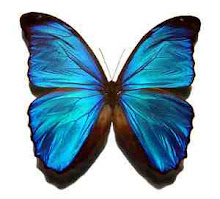
The Real Blue Morpho
For as long as I can remember I have been a little obsessed with butterflies. They quickly attract my attention, and if one is floating by I'll stop everything to watch it. When I was a child they seemed like fairies. Beautiful, fast moving, colorful things will attract the attention of any child, of course, but I'm still suffering pretty acutely with this ADD behavior around butterflies.
As I became a little older, about high school, I started identifying more with the idea that butterflies represented a glorious end-state. What starts as a crawling caterpillar bursts forth into a beautiful, winged, angelic creature - a perfect metaphor for growing up and getting an adult life of my own. I started using butterflies now and then as images to represent myself.
And then, as more years went by and the true extent of my mental illnesses became apparent, the butterfly represented a new dimension of change - changing from something lowly, even ugly, that must crawl, into something gorgeous, heavenly, perfect, that can fly. This was the change I wanted to make, and I started using butterflies as my icons all the time. I collect stamps, and I found a few butterfly stamps that I would take out and look at regularly.
In graduate school I visited one of those live butterfly exhibits, this one in Houston. You can sit in a replicated rain forest, quietly on a bench, and watch scores of butterflies flitter less than a dozen feet away. I saw a real blue morpho butterfly alive for the first time. One landed on my arm. Several butterflies had landed on me that day, but it was the brilliant blue one that had me riveted. Wow. Blue has always been my favorite color It became the indelible icon of my hope for greater mental health.
The symbol of freedom.
A butterfly even flew around under the wedding canopy during my wedding ceremony, and we all couldn't help but consider it a good omen.
The last few years have been a struggle to alter the image into something a little more accepting. The idea I have been moving towards as a result of my mediation is that I am already the butterfly. This is me, and this is now. I might feel like a caterpillar, but the wings are already in place. As enlightenment is likened to a flower, slowly opening its petals, I now see myself as a butterfly learning to spread her wings. The idea is to focus on that acceptance, that realization. We are not ugly. We are not broken. We are already gorgeous butterflies who need to open our wings and get some flying lessons.
My sister surprised me with an amazing birthday present this year, a real (sustainably farmed, previously deceased by natural causes) blue morpho butterfly. While it feels a little strange to my OCDs to bring a dead insect into the house, the basement is already full of them, living and late. :) Besides, I'm not so literally minded that I equate myself to a dead butterfly preserved in glass - that would be more the princess trapped in an ivory tower thing. Definitely not my self image. In any case I thought it was a fabulous gift and put it on the wall over my desk.
It is beautiful, a wonderful symbol and reminder. You are beautiful. You are already what you are supposed to be. Freedom is right now. Open your wings and fly.
Your Hostess With Neuroses
Image credit/info: My own blue morpho
Thursday, June 2, 2011
Investing in Ourselves - Treating the Whole Person
The scientific literature for anxiety and depression continues to amuse, entertain, and on rare occasion actually enlighten. I'm not even sure why I read the journals, since for the most part my only comment is "no duh." But my psychologist continues to remind me that there is a difference between something being obvious to me as a sufferer of mental illnesses, and having actual metrics and research to back it up. At least we have more and better ways to explain how crappy we feel.
But I don't want to actually get too down on it. As a scientist I love research and data, I just wish these papers I read would say something really surprising. I wish they would offer a jolt of realization, a truly new idea or approach. Instead they say things like, "The people with GAD in this study felt bad, and the people with GAD as well as other diagnoses felt really bad." In spite of everything, I keep hoping to spot that magic formula, that golden key that will unlock the mess that is my mind and make everything come together.
One advantage of reading over and over things you could have told the researcher yourself is validation. There is now a lot of research backing up what many of us have been saying for years. It gives me more faith in myself and my perception of my own situation. And in spite of my belly-aching, the fact that I do keep reading the journals must mean I am enjoying it to some extent. It's hardly required reading.
Anyway, here is something that caught my eye in the April 2011 issue of Depression and Anxiety. (Yes, I'm behind in my reading.) Hollon wrote a report entitled "Cognitive and Behavior Therapy in the Treatment and Prevention of Depression." Here is an interesting quote about ADMs (Antidepressant Medication) "A recent reanalysis of the FDA database for all registered trials for a dozen of the more recently approved medications (including the bulk of the SSRIs) found evidence of substantial publication bias. Trials that produced positive findings almost invariably found their way into the literature, whereas trials that did not either were never published or were published in a manner that made the target medication appear to be efficacious when it was not."
This is sad, but not unexpected. Null results are always harder to publish, and large drug companies that fund many studies are not going to promote a paper that shows their drug is mediocre. The reason I honed in on this is because I am a strong advocate for multiple kinds of therapy being used together - an integrated, holistic approach to treating people as whole people. In my case, that means both meds and talk therapy, as well as other things. I've known too many people who chose to treat depression with meds, and nothing else. Hollon goes on to say, "Finally, there is no evidence that having taken ADM does anything to reduce risk for subsequent symptom return and standard practice has evolved over the last several decades to keep most patients who respond on medication indefinitely."
And, well, some of us may need that. I'm not sure I'll ever be in a position to go off the meds completely. I had four major depressive episodes that were completely untreated, and that carves quite a biochemical path through the brain. Still, I do not think this means everyone needs the meds forever, as is the current trend. I also think that concentrating on just meds means that a lot of people who need deeper intervention never get it. There are people who would improve and take control of their lives in a whole new way if they had the right combination of treatment. Some talk/cognitive/acceptance type therapies DO have evidence to show a reduced risk for subsequent symptom return. And that is certainly some data that shouldn't be ignored.
I think as patients we need to be sure we advocate for the treatments we need - what we know works for us as individuals and complete people - rather than what is the trend of the moment. Research is great stuff, but in the end, bias shows up in the literature the same as it does in any human endeavor.
The literature can point us all over the place. I advocate that the investment we need to make in ourselves is to treat ourselves as whole people, who need a host of things like good food, sleep, and social interaction. Our minds and bodies are working with the same chemistry, and are the same electrical system. We need all kinds of options, like meds, CBT, ERT, talk therapy, DBT, yoga, meditation, acupucture, and more, to create a therapy program that really moves us forward in our healing.
Your Hostess With Neuroses
Image credit/info: [F]oxymoron, The Chemistry of Inversion, Creative Commons via Flickr CC 2.0
Wednesday, May 18, 2011
Learning More About Grief, the Hard Way
Hello Friends:
I lost a friend a few days ago. I had intended to blog about it immediately, but was still sort of in shock. Or denial. Definitely denial, since I can feel this "how can this person not exist anymore" sensation. I had known for several months that she had cancer, something with a bad prognosis. But the last report just a week or so ago was that she was in treatment, battling hard, still writing papers and grading tests. And then this. She was 47, and as full of life and willpower as anyone I'd ever met.
I am really tired of people dying. In the last several years I've lost my father-in-law, a grandmother, a grandmother-in-law, several science colleagues ... it's a bit of a list. Some were older, and had been ill for some time. That doesn't help, but facing the stark inevitability of someone elderly passing away is at least vaguely comprehensible. Some were younger, like my friend. This is not comprehensible. Not computing.
I've written before on the problem of grieving past losses. I know part of the healing process is looking back on an abusive and traumatic past and learning how to grieve what never was. Not that I'm particularly good at it. It's just too hard, and seems sort of optional. Who wants to go digging, even if you know you need to deal with that loss eventually? It seems ignorable. Easy to focus on other "more pressing" issues. And then something like this happens, and grief and loss come and slap you in the face. There is no escape from this.
You can feel the echoes through your whole psyche - it feels too familiar - and you realize your interior tapestry is largely woven from sadness, grief, and loss. That past is the fiber inside of you, and this new grief is catching on the threads, caught, tangled. You have an inclination to grab a pair of scissors and cut it out, every spot of grief and pain. But you get some semblance of sanity, and realize you'll end up with an inside full of more holes than you already have. You can't cut your memories away without cutting yourself out along with it. It is so much harder to try to darn and re-weave, but that's the choice. Hardly profound, but facing facts is one of those things I'm trying to get myself to do right now.
I don't want to forget my friend. It hurts, but I want to go on remembering. It's important. She deserves to be remembered and her life deserves to be celebrated.
Not that I feel like celebrating at the moment.
Your Hostess With Neuroses
Image credit/info: Sky Cries Mary by frantikgirl on flickr via Creative Commons, CC 2.0
Friday, February 18, 2011
Words Through the Walls
I am, this very moment, hearing my neighbors arguing. I live in a townhouse with reasonably thick walls, but yelling, loud music, and such can be heard pretty clearly.
This couple has a loud argument about once a month. They have done this for the last three years. Usually I immediately play music to drown it out, leave the house, or start up with an engaging video game until they are done. Usually lasts 15 minutes to half an hour, and then they seem to wind down. I try to avoid hearing them because (1) I really don't have any interest in knowing what my neighbors are doing, I am not nosy or gossipy by nature, but more importantly (2) hearing the sound of yelling in an argument makes me really, really uncomfortable. Scared. Angry. Sad. Confused. Then scared again. These arguments really, really upset me. I get a sensation that I'm going to freak out, and can't move fast enough to find a way to drown it out.
This is hardly a huge shock, given how I grew up. The yelling at us kids for stupid things. And worse, the yelling between my parents that would always be turned on us once they got tired of yelling at each other. I was raised in a chaotic environment where verbal abuse, loud and otherwise, was commonplace. And having been raised that way, it is again no surprise that I repeated this pattern of self-abuse by living with an emotionally and occasionally physically abusive boyfriend for five years. So I am understandably very touchy when it comes to couples yelling at each other.
The thing that makes this argument different is that I am intentionally not tuning it out. I've chosen to practice my mindfulness in this really uncomfortable situation. I'm going to sit here and listen to this. I'm going to feel what I feel. I'm not going to judge myself or try to keep from feeling unhappy. I'm just going to sit with this discomfort. I'm going to think thoughts, ask questions, but I'm not going to avoid anything. No avoidance. This is really hard. There is a rock in my stomach. My palms are sweaty.
And it is still going over there. Loud and scary. I can hear, actually hear, the sound of my parents arguing in my head. I feel like I am being yelled at, personally. This is a bad one even for the neighbors. It has already been a half hour. Why does a woman stand there and let a man call her a *uk#ing idiot? Why does a man stand there and let a woman call him a lazy bastard? These are somewhat rhetorical questions, since as I said I was in an abusive relationship, and at the time I thought I deserved the abuse. That I wasn't worth anything better. That I could never find anything better. I was also afraid to leave. I was afraid he would stalk me, hurt me. So yes, I get why people might do it. But ... but really. Now that I'm out of it, no, I don't get it.
Good grief, he is actually mocking her now. Mocking. A sing song voice. The tone makes me want to tear someone's eyes out. Wait. Now they are yelling about who is at fault that each one of them no longer has friends. Their words through the walls are loud and perfectly clear. I'm choking down pained laughter. If they would actually listen to themselves, the 'lack of friends' would be less of a mystery. I sure have no interest in them.
My husband and I never yell at one another. Not now, not ever. Not once. We've had a few heated arguments in the 17 or so years we've been together, but never yelling. Part of the reason, of course, is that I can't abide it. He is much less sensitive to it, given the normal volume of conversation in his house growing up was yelling, even when people were perfectly happy. But even so, he agrees it is much more pleasant without the constant noise.
Okay, now it is so loud it is garbled. Um. He's saying "You are an a$$hole to me. You haven't changed at all." She is too shrill to be understood. I realize I am actually afraid of ... of him doing something like ... well ... firing a gun. I have this image of a gun going off, and a bullet flying through the wall and killing me. How ... bizarre. I ... you know, I have that thought every time they yell over there. Somehow ... somehow I see their arguing as a direct threat to me. A threat to my life. Well, of course I do. But now that I think about it, that's me doing ...
Oh, for heaven's sake, I'm having a flashback. Of course I am. I don't mean to say I've been shot at. It's not that literal. I have Chronic PTSD, not trauma from a single event. When I flashback, I find myself caught in an amalgam of events; a mix of memories, some clear, some vague. So it takes me 45 minutes to realize I'm in the middle of a flashback. It does usually take a while since I don't have any visual symptoms. I don't 'see' the past. But I can hear it, smell it, even feel it. My eyes see 'now.' The rest of me is perceiving a blur of events from long ago. My heart is pounding, I can hear my parents yelling, at each other, at me. I am ... I am a little girl hiding in a corner.
And as soon as I started writing the above paragraph, I started feeling more normal. Realizing it wasn't 'real,' wasn't 'now' helped it go away. I have no evidence that things next door have ever gotten physical. Just yelling. There is no indication or evidence that any kind of violence has or will happen over there. My fear of being hurt is completely unfounded in the 'now'. It is entirely the past. I'm there, living it as if it were the present.
It's been an hour. They are finally done.
That sucked.
Was it worth it? Hmm. I'm an experimentalist, so it's hard to say an experiment was useless. Even a null result is a result. I didn't actually freak out. I had a flashback. I probably always do and never realized it before, even when I turn up the music, since I am always rattled for hours after they shut up. Running from it did not make the fear stop. I can't say confronting it made the fear stop, since I feel like total crap right now.
But if nothing else, I did just prove to myself that I can live through an argument. The yelling alone can't kill me. I did not 'freak out' any more than usual. And I also have some more proof about how tough it can be to tell the difference between a PTSD flashback and a nasty GAD anxiety attack. They seem so similar on the surface, but a flashback is more insidious. Darker. Deeper. Tangled.
Whatever. I deserve a reward. Chocolates. I know I shouldn't use food. Too bad.
Your Hostess With Neuroses
Image credit/info: The Sun Goes Down, gideon_wright on Flikr via Creative Commons, CC 2.0
Popular Posts
-
Hello Friends: Yes, I too am on the book-tour wagon-train for " I Hardly Ever Wash My Hands - The Other Side of OCD " by J.J. Ke...
-
Hello Friends: I was far, far too optimistic to hope I had managed to rid my abode of mice. A week after we returned from our trip, my sp...
-
Hello Friends: I'll explain the title of this post in a minute, but I need to wander off (potentially way off) topic and then back aga...
-
Hello Friends: Long time no blog - well, a month, anyway. I always forget how crazy the end of the year can be. November is particularly...
-
Hello Friends: Back after another hiatus. It is starting to get easier to come back and try to take up where I left off. Less guilt abou...